
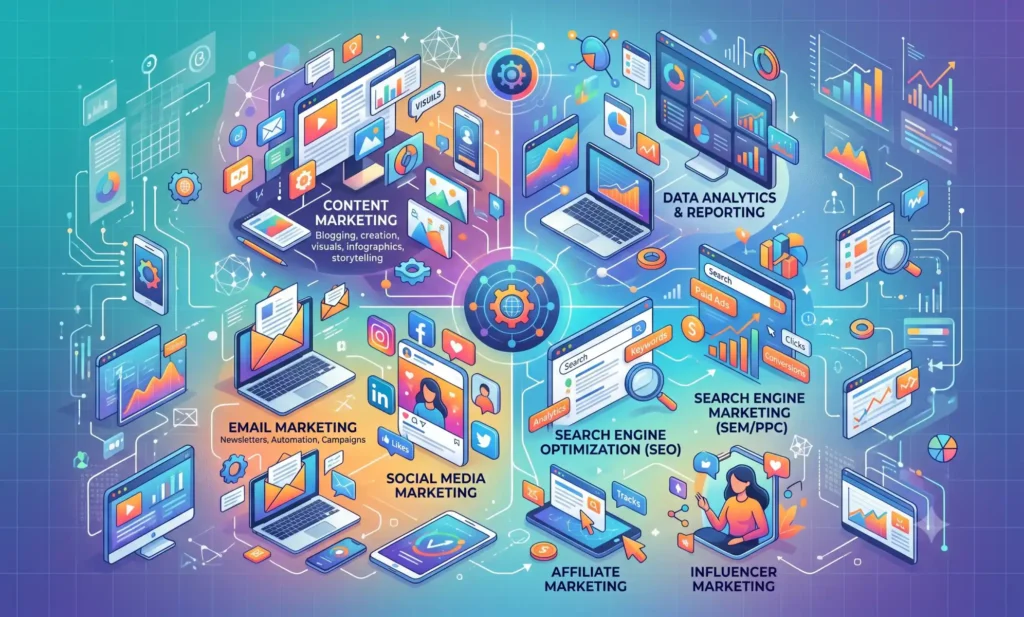
Digital marketing has become an essential part of how modern businesses reach customers, build their brands and generate sales. From a small local business promoting itself on Instagram to a global company running targeted advertising campaigns, digital channels have changed the way businesses communicate with their audiences.
But digital marketing is much more than posting on social media. It combines search engines, websites, content, social media, email, paid advertising and data analytics to attract the right audience and turn interest into meaningful business results.
What Is Digital Marketing?
Digital marketing is the use of digital channels, platforms and technologies to promote products, services or brands and connect with potential customers.
Unlike traditional marketing, digital marketing allows businesses to reach specific audiences, measure campaign performance and adjust their strategies based on real-time data.
Some of the most common digital marketing channels include:
- Search engines such as Google
- Social media platforms
- Business websites and blogs
- Email marketing
- Online advertising
- Video platforms
- Content marketing
- Mobile applications
The main objective is not simply to get attention. Effective digital marketing aims to build awareness, create trust, generate leads and ultimately encourage customers to take action.
Why Is Digital Marketing Important?
Consumers increasingly use the internet to discover businesses, research products, compare prices, read reviews and make purchasing decisions.
This makes an online presence important for businesses of almost every size.
For example, a potential customer may discover a company through a Google search, visit its website, watch one of its videos, read customer reviews and finally make a purchase after seeing a targeted advertisement.
Digital marketing connects these different stages of the customer journey.
It can also provide businesses with measurable information. Marketers can track website visits, clicks, leads, conversions, advertising costs and other performance indicators to understand what is working and what needs improvement.
The Core Pillars of Digital Marketing
Digital marketing consists of several interconnected areas. Businesses don’t necessarily need to use every channel at once, but understanding the major pillars helps create a more effective strategy.
1. Search Engine Optimization (SEO)
Search Engine Optimization, or SEO, is the process of improving a website so that it can appear more prominently in relevant search results.
SEO involves several activities, including:
- Keyword research
- Helpful and relevant content
- On-page optimization
- Technical SEO
- Internal linking
- Website performance
- Quality backlinks
- Mobile-friendly design
For example, if someone searches for “best filmmaking course in Mumbai,” a filmmaking academy can use SEO to improve the chances of its relevant webpage appearing in search results.
SEO generally takes time and requires consistent effort, but it can become an important source of long-term organic traffic.
2. Content Marketing
Content marketing focuses on creating useful and relevant content for a specific audience.
This can include:
- Blog articles
- Videos
- Podcasts
- Guides
- Infographics
- Case studies
- Social media posts
- Newsletters
Good content answers questions, solves problems or provides useful information.
For example, a financial website might publish articles explaining mutual funds, stock-market basics and investment concepts. A filmmaking academy might publish tutorials about screenplay writing, acting or film direction.
The purpose is to build familiarity and trust rather than simply promote a product in every piece of content.
3. Social Media Marketing
Social media provides businesses with a direct way to communicate with their audience.
Platforms such as Instagram, Facebook, LinkedIn, YouTube and other networks can be used for:
- Brand awareness
- Community building
- Educational content
- Customer engagement
- Product promotion
- Lead generation
- Paid advertising
The most effective social media strategy is usually more than simply posting frequently. Businesses need to understand their audience, create useful content and engage with people consistently.
Different platforms also attract different audiences, so businesses should choose platforms according to their goals and target customers.
4. Paid Advertising
Paid advertising allows businesses to reach potential customers by paying platforms to display advertisements.
Popular forms include:
- Google Search Ads
- Display advertising
- YouTube advertising
- Meta advertising
- Social media promotions
- Remarketing campaigns
One major advantage of paid advertising is speed. A business can potentially reach a targeted audience soon after launching a campaign.
However, paid advertising requires careful management. Poor targeting, weak advertising copy or an ineffective landing page can result in wasted spending.
Successful campaigns generally require continuous testing and optimization.
5. Email Marketing
Email marketing remains an important digital marketing channel because it allows businesses to communicate directly with people who have already shown interest in their brand.
Businesses can use email to send:
- Newsletters
- Product updates
- Special offers
- Educational content
- Event announcements
- Follow-up messages
Unlike social media, where algorithms influence who sees a post, an email list gives businesses a more direct communication channel with subscribers.
The quality and relevance of the emails are important. Sending excessive or irrelevant messages can cause subscribers to lose interest.
6. Analytics and Data
Data is one of the most important parts of modern digital marketing.
Tools such as Google Analytics, advertising dashboards and other analytics platforms can help marketers understand:
- Where visitors come from
- Which pages they visit
- How long they stay
- Which campaigns generate leads
- Which advertisements generate conversions
- How much a campaign costs
- Which channels produce better results
Without measurement, businesses may spend money on marketing without knowing whether their efforts are actually producing results.
Data doesn’t replace creativity, but it helps marketers make more informed decisions.
The Role of Artificial Intelligence in Digital Marketing
Artificial intelligence is becoming increasingly important in digital marketing.
AI tools can assist marketers with tasks such as:
- Generating content ideas
- Analyzing large amounts of data
- Creating advertising variations
- Personalizing customer experiences
- Automating customer support
- Identifying audience patterns
- Assisting with keyword and content research
AI can improve efficiency, but human judgment remains important. Generated content still needs to be checked for accuracy, originality, relevance and brand consistency.
The future of digital marketing is likely to involve a combination of human creativity, marketing expertise, data and AI-powered tools.
Personalization Is Becoming More Important
Consumers are exposed to a huge amount of online content every day. As a result, generic marketing messages can easily be ignored.
Personalization allows businesses to provide more relevant experiences based on factors such as customer interests, previous interactions, location or purchasing behaviour.
For example, an online store may recommend products based on what a customer previously viewed or purchased.
When used responsibly, personalization can make marketing communication more relevant and useful.
Voice Search and Conversational Marketing
People increasingly interact with technology through voice assistants, smartphones and conversational interfaces.
This has created new opportunities for businesses to optimize their content around natural-language questions.
Instead of targeting only short keywords, businesses can also create content that directly answers questions such as:
- What is digital marketing?
- How does SEO work?
- How can I start a digital marketing career?
- What are the benefits of Google Ads?
This approach can also make content more useful for AI-powered search and conversational platforms.
How to Start a Career in Digital Marketing
Digital marketing offers several career paths, but beginners don’t need to master everything at once.
A practical approach is to start with the fundamentals and gradually specialize.
Step 1: Learn the Basics
Start by understanding:
- SEO
- Content marketing
- Social media marketing
- Google Ads
- Email marketing
- Analytics
Step 2: Choose One Area to Explore Deeply
You could specialize in areas such as:
- SEO
- Performance marketing
- Social media
- Content marketing
- Email marketing
- Marketing analytics
Developing strong skills in one area can make it easier to build professional experience.
Step 3: Create a Portfolio
A portfolio can demonstrate your skills even when you don’t have extensive professional experience.
You can create:
- A personal blog
- An SEO project
- Sample advertising campaigns
- Social media content
- Case studies
- Website optimization projects
Practical projects can often demonstrate your abilities better than simply listing completed courses.
Step 4: Gain Real-World Experience
Internships, freelance projects, personal websites and small business projects can provide valuable practical experience.
Digital marketing changes quickly, so continuous learning is also important.
What Does the Future of Digital Marketing Look Like?
Digital marketing will continue to evolve as technology, consumer behaviour and online platforms change.
Several trends are likely to remain important:
- Artificial intelligence and automation
- Personalized marketing
- Video content
- Search optimization for conversational queries
- Data-driven decision-making
- Influencer and creator marketing
- Interactive and immersive experiences
- First-party customer data
However, technology alone does not create successful marketing.
Understanding the audience, communicating clearly and offering something genuinely useful will remain at the centre of effective marketing.
Final Thoughts
Digital marketing is no longer limited to advertisements or social media posts. It is a broad ecosystem that combines content, search, websites, social media, advertising, email and analytics.
For businesses, learning how these channels work together can create opportunities to reach customers more effectively and measure marketing performance.
For individuals, digital marketing can also provide a range of career and freelance opportunities.
The tools will continue to change, but the fundamental principle remains the same: understand your audience, provide value, communicate effectively and use data to improve your results.
Frequently Asked Questions About Digital Marketing
What is digital marketing in simple words?
Digital marketing means promoting a business, product, service or brand through digital channels such as search engines, websites, social media, email and online advertising.
How can a beginner start learning digital marketing?
A beginner can start by learning the fundamentals of SEO, content marketing, social media, paid advertising and analytics. Building small practical projects can help turn theoretical knowledge into real skills.
Is digital marketing a good career in 2026?
Digital marketing continues to be used by businesses across many industries, creating opportunities in areas such as SEO, performance marketing, social media, content creation and analytics. Career opportunities vary according to skills, experience, location and market demand.
How long does it take to learn digital marketing?
The fundamentals can be learned in a few months with consistent study and practice. Becoming highly skilled takes longer because digital platforms, technology and marketing practices continue to evolve.
Is SEO part of digital marketing?
Yes. SEO is one of the major components of digital marketing. It focuses on improving a website’s visibility in organic search results.
Can digital marketing be done without a large budget?
Yes. Businesses can start with relatively low-cost methods such as organic SEO, content marketing, social media and email marketing. Paid advertising can be added gradually when the business has a suitable budget and clear objectives.