
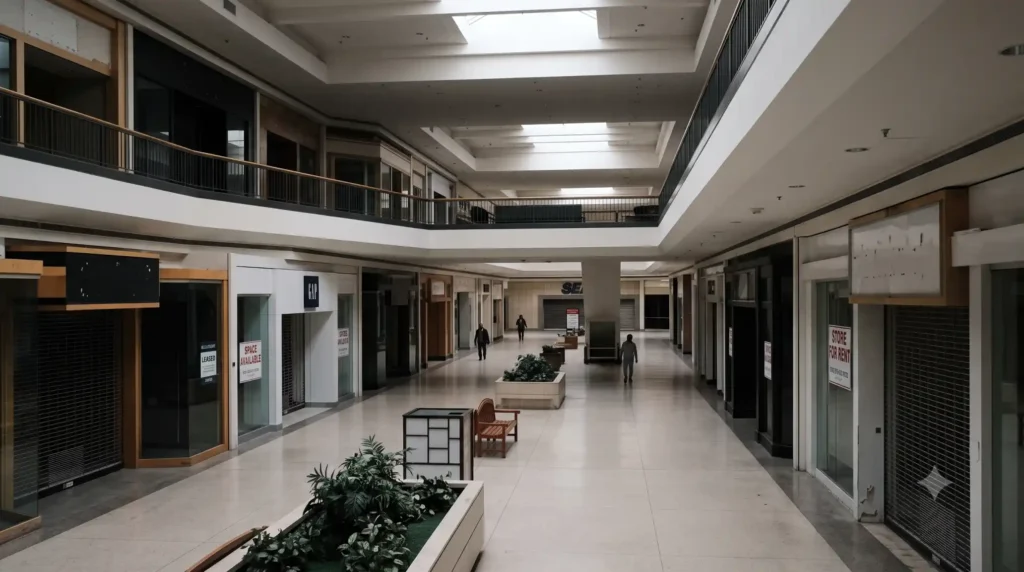
Shopping malls were once the beating heart of American consumer culture. They were places where teenagers hung out on weekends, families spent entire afternoons browsing, and communities gathered around food courts and movie theaters. Today, that picture has changed dramatically. Across the United States, once-thriving shopping centers sit half-empty, their parking lots cracked and overgrown, their corridors echoing with the footsteps of a few remaining shoppers. The question on everyone’s mind: why are shopping malls dying? The answer is more complex than simply blaming Amazon.
The Oversupply Problem
One of the most fundamental issues facing American malls is that there are simply too many of them. The United States has historically maintained far more retail space per capita than any other major economy—nearly 23 square feet per person . For decades, developers kept building, confident that consumer spending would keep pace. It didn’t.
As of 2025, roughly 1,200 malls remained operational across the country. Industry projections suggest that number could fall to just 900 by 2028 . The math is unforgiving: fewer malls are needed because fewer shoppers are visiting them regularly.
Anchor Stores Are Disappearing
Traditional malls relied on a simple formula: anchor the property with major department stores, fill the corridors with apparel chains, and watch the foot traffic flow. That formula has collapsed. Anchor tenants like Sears, Lord & Taylor, and Macy’s have closed hundreds of locations, leaving massive vacant spaces that smaller retailers depended on for customer traffic .
When an anchor store closes, the domino effect is brutal. Shoppers no longer have a reason to walk to that end of the mall. Smaller retailers see their sales plummet. They close too. The result is the “zombie mall”—a property that remains technically open but is functionally dead, with occupancy rates so low that it can never recover .
The Experience Gap
Here’s the uncomfortable truth that many retailers ignored for too long: malls stopped giving people a compelling reason to visit. As Ward Kampf, president of Northwood Retail, put it, “A lot of stores just grew to grow” without offering shoppers anything they couldn’t get online .
E-commerce didn’t just steal sales—it changed expectations. Consumers now expect convenience, selection, and competitive pricing. When a mall offers the same mass-market products at higher prices with the added friction of parking and crowds, the value proposition falls apart. Only malls that offer something genuinely different—entertainment, dining, luxury, community—have managed to stay relevant.
The K-Shaped Split: Winners and Losers
Not all malls are dying. In fact, the retail landscape has split sharply into two tiers. Class A malls—typically luxury-leaning properties in affluent areas—are thriving. Roosevelt Field on Long Island, for example, boasts 96% occupancy with tenants like Hermès, Rolex, and Armani driving sales of roughly $1,250 per square foot .
Meanwhile, the bottom 350 malls in the country account for just 10% of the sector’s value . These are the properties most likely to close. The middle ground—mid-tier malls catering to middle-income shoppers—is disappearing fastest, squeezed between luxury destinations at the top and convenient strip centers and online retail at the bottom.
What’s Replacing Dead Malls?
The good news is that many dying malls are finding new life through adaptive reuse. Approximately 40% of empty malls are being repurposed into warehouses, residential housing, or community centers . Others are transforming into mixed-use developments that combine retail with apartments, offices, and entertainment venues .
The most successful transformations follow a “live-work-shop-play” model. Former anchor store spaces have become medical offices, gyms, and even college classrooms. Food courts are giving way to full-service restaurants and grocery stores that generate repeat visits throughout the week .
The Global Picture
Interestingly, the mall crisis is not uniform worldwide. India, for example, is experiencing a more complex situation. While older malls in Delhi-NCR and other regions are becoming “ghost malls” with high vacancy rates, demand for Grade A retail space remains strong in tier-2 cities . The difference lies in market maturity: India overbuilt in the early 2000s without the deep consumer base to sustain it, but newer, better-designed malls continue to attract brands and shoppers.
In Spain and Mexico, declining malls have survived by repositioning as commercial and service hubs for nearby residential areas, changing their functional mix to serve local communities rather than drawing regional shoppers .
The Future of Retail Spaces
The mall isn’t dead—but the generic, undifferentiated mall is. The survivors will be those that offer experiences, convenience, and community that online retail cannot replicate. Grocery-anchored centers, lifestyle destinations with fitness and wellness tenants, and luxury properties with strong curation will continue to thrive .
For everyone else, the reckoning continues. The shopping mall as we knew it—a cathedral of consumerism anchored by department stores and filled with apparel chains—has reached the end of its life cycle. What replaces it will depend on whether developers can create spaces that people genuinely want to visit, not just shop.
Key Takeaway: Shopping malls are dying because of oversupply, the collapse of anchor tenants, changing consumer habits, and the rise of e-commerce. The malls that survive will be those that reinvent themselves as experience-driven destinations rather than pure retail centers.