
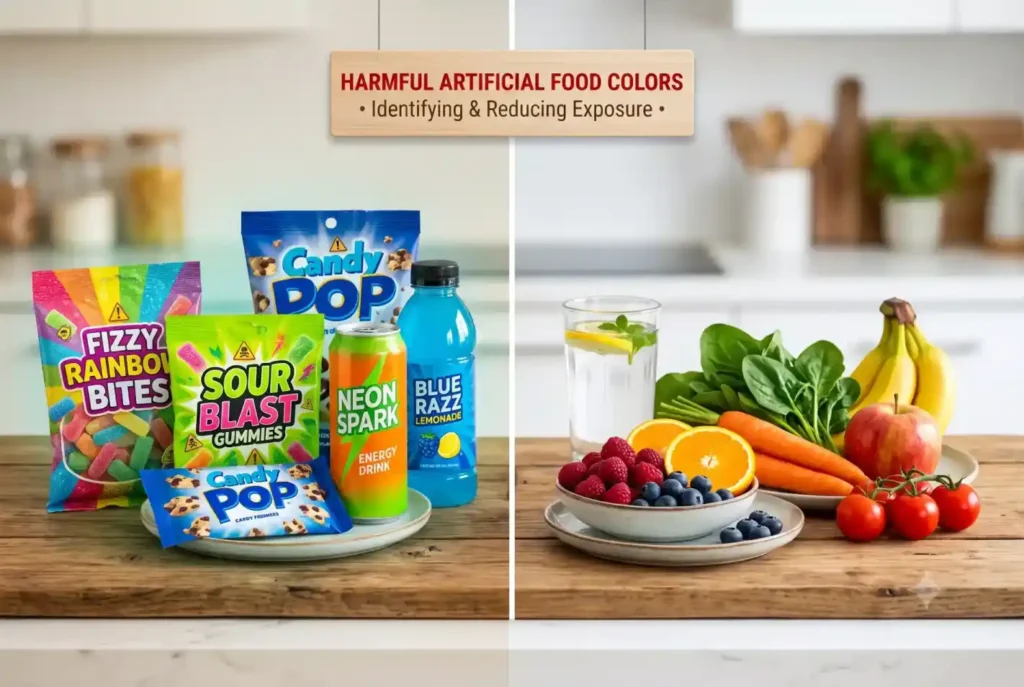
Brightly colored sweets, soft drinks, ice creams, candies and packaged snacks are a familiar sight in India. Their attractive appearance can make them appealing, particularly to children. But have you ever wondered what gives some of these foods their intense red, yellow, green or blue colors? In many cases, the answer is artificial food color.
Artificial food colors are used to make food look more attractive, maintain a consistent appearance or replace color lost during processing. Although approved food colors are regulated for use, questions remain about their possible health effects, particularly when it comes to certain dyes, allergic reactions and children’s behavior.
Understanding what scientific research actually says can help consumers make informed choices without unnecessary fear or misleading claims.
1. What Are Artificial Food Colors?
Artificial food colors are substances manufactured or processed for use in coloring foods. Many synthetic food dyes are derived from chemical starting materials and are designed to produce consistent, vivid colors.
Food manufacturers may use them in products such as:
- Candies and chewing gum
- Soft drinks and flavored beverages
- Ice creams and desserts
- Cakes, biscuits and bakery decorations
- Packaged snacks
- Certain sauces and confectionery products
Some commonly discussed synthetic dyes include Tartrazine (Yellow 5), Sunset Yellow FCF (Yellow 6), Allura Red AC (Red 40) and Brilliant Blue FCF (Blue 1). Their permitted use depends on the country’s food regulations and the type of food involved.
Not every bright-colored food contains artificial dyes. Some products use natural colorants, while others get their appearance from their ingredients.
2. What Does Science Say About Their Health Risks?
The health effects of artificial food colors are not identical across all dyes or all consumers. Scientific assessments consider the specific substance, how much a person consumes and how the body responds.
Possible allergic and intolerance reactions
Some people report reactions after consuming particular food additives, including certain synthetic colors. Reported symptoms may include itching, hives or other skin complaints. However, confirmed allergic reactions to approved synthetic food colors are considered uncommon.
A reaction after eating a colored food does not automatically establish that the dye was responsible. Other ingredients, including milk, nuts, flavorings and preservatives, may also be involved.
Anyone who experiences repeated or severe reactions should seek medical advice rather than attempting to diagnose the cause independently.
Possible effects on children’s behavior
One of the most widely discussed research topics is whether certain artificial food colors can affect children’s attention or activity levels.
Some controlled studies have found small changes in activity or attention-related behavior in some children after exposure to mixtures of certain colors and preservatives. However, the findings do not establish that all artificial food colors cause ADHD or that every child will respond in the same way.
The distinction matters: a possible behavioral effect in some children is not the same as proof that food dyes cause a neurodevelopmental disorder.
Other long-term health concerns
Artificial food colors are sometimes linked online to cancer, organ damage and other serious diseases. These claims need to be evaluated dye by dye, using reliable toxicological studies and regulatory assessments.
It is not scientifically accurate to say that every approved artificial color causes cancer or damages organs. Equally, regulatory approval does not mean that every possible question about long-term exposure has been answered forever.
Consumers should distinguish established risks, potential effects under investigation and unsupported claims.
3. How Are Artificial Food Colors Tested for Safety?
Food colors are assessed using toxicological evidence, including studies that examine how substances are absorbed, metabolized and eliminated, as well as their possible effects at different doses.
A key concept in food-additive safety is the Acceptable Daily Intake (ADI). It is an estimate of the amount of a substance that can be consumed daily over a lifetime without appreciable health risk, based on the available evidence and safety factors.
An ADI is not a recommended amount to consume. It is also not a guarantee that an individual cannot experience an intolerance or other reaction.
Different authorities may assess evidence and authorize different colors or uses. In India, the Food Safety and Standards Authority of India (FSSAI) regulates permitted food additives, including synthetic food colors, through food-safety regulations.
The important point is that safety depends on the specific color, its permitted use and the level of exposure, rather than simply whether a food looks brightly colored.
4. Artificial Food Colors in India
In India, food manufacturers must follow applicable FSSAI requirements for permitted additives and food labeling.
Consumers should pay attention to the ingredient list on packaged products. Depending on the product and applicable labeling requirements, colors may be identified by their common names, additive names or other prescribed declarations.
A brightly colored product is not automatically unsafe or illegal. However, consumers should be cautious about foods with unclear ingredient information, especially unpackaged products from sources that cannot explain what coloring substances they use.
For loose sweets, decorative food products and other items sold without a complete package label, asking the seller about the ingredients can be useful.
If a product appears to use an unauthorized color or has misleading labeling, consumers can check the relevant food-safety requirements and use the appropriate consumer complaint channels.
5. How to Reduce Unnecessary Exposure
People who want to limit artificial food colors do not necessarily need to eliminate every processed food. A practical approach is to pay attention to frequent consumption and choose a varied diet.
Read food labels
Look at the ingredients list rather than relying only on packaging photographs or marketing descriptions. Learn to recognize the names of colors you wish to avoid.
Limit frequently consumed brightly colored treats
If a child regularly consumes brightly colored candies, sugary drinks and desserts, consider replacing some of these with ordinary foods and less heavily colored alternatives.
The goal is not to treat color as the only measure of nutritional quality. Sugar, overall dietary pattern and portion size also matter.
Choose naturally colorful foods
Fruits and vegetables provide a wide range of natural colors, including those from carotenoids, anthocyanins and chlorophyll.
Examples include carrots, tomatoes, spinach, beetroot, oranges and berries. These foods also provide nutrients and fiber, making them useful choices for a balanced diet.
Natural colors are not automatically harmless in every circumstance, but eating a variety of whole foods is a sensible general dietary practice.
Avoid misleading claims
Terms such as “natural,” “chemical-free” or “toxin-free” can be used loosely in marketing. Evaluate the actual ingredient list and the product’s nutritional quality instead of assuming that a particular label guarantees health benefits.
6. Artificial vs Natural Food Colors
| Feature | Artificial colors | Natural colors |
|---|---|---|
| Source | Manufactured synthetic substances | Plant, animal or other natural sources |
| Appearance | Often vivid and consistent | May vary with source and processing |
| Stability | Some are highly stable | Varies by colorant and conditions |
| Safety | Depends on the specific additive and exposure | Also depends on the substance and exposure |
| Food use | Regulated permitted applications | Regulated permitted applications |
The word “natural” does not automatically mean safer, and “artificial” does not automatically mean harmful. Both types of coloring substances should be evaluated based on evidence, permitted use and actual exposure.
7. A Practical Food-Color Awareness Checklist
Before buying a brightly colored packaged product, consider these questions:
- Is the ingredient list available and understandable?
- Does the product contain a colorant I prefer to avoid?
- Is it something I consume occasionally or every day?
- Is the product also high in added sugar or low in nutritional value?
- Are there simpler alternatives that I would enjoy just as much?
- Am I relying on a scientific source or an alarming social media claim?
For parents, it may be useful to notice whether a child repeatedly experiences a particular symptom after eating a particular product. Keep a record and discuss recurring concerns with a qualified healthcare professional rather than restricting many foods without guidance.
8. Why Public Awareness Matters
Public awareness about artificial food colors should focus on reliable information, transparent labeling and sensible food choices.
Overstating the evidence can create unnecessary anxiety and distract consumers from other important aspects of nutrition. Ignoring genuine concerns can also prevent people from making informed decisions.
Consumers, parents, food businesses and educators all have a role in promoting accurate information. Understanding the difference between a permitted additive, a possible sensitivity and a proven health risk is an important part of food literacy.
Frequently Asked Questions
1. Are artificial food colors harmful to everyone?
No. The effects depend on the particular color, the amount consumed and individual sensitivity. Approved colors are subject to safety requirements, although some people may experience reactions or other effects associated with particular substances.
2. Can artificial food colors cause ADHD in children?
Current evidence does not establish that artificial food colors cause ADHD. Some studies have reported small behavioral effects in certain children, but these findings should not be confused with proof of causing the disorder.
3. Which artificial food colors should consumers know about?
Commonly discussed examples include Tartrazine, Sunset Yellow FCF, Allura Red AC and Brilliant Blue FCF. Their permitted uses vary by jurisdiction, so consumers in India should refer to applicable FSSAI requirements and product labeling.
4. Are natural food colors safer than artificial food colors?
Not necessarily. Natural and synthetic colorants have different properties, and safety depends on the specific substance, dose and use. The source alone does not establish whether a colorant is safe.
5. How can I identify artificial food colors in packaged foods?
Read the ingredient list and look for declared color additives or their prescribed names. If you are unsure about a particular product, check the manufacturer’s information or applicable food-labeling requirements.
6. Should parents completely avoid artificial food colors?
There is no universal recommendation that every family must eliminate all approved food colors. Parents can make informed choices based on their child’s diet, any recurring reactions and advice from qualified healthcare professionals.
7. Are brightly colored Indian sweets unsafe?
Not simply because they are brightly colored. Their safety depends on the ingredients, permitted additives, manufacturing practices and compliance with food regulations. Consumers should buy from reliable sources and be attentive to ingredient and quality information.
Scientific Evidence and Official References on Artificial Food Colors
To understand the possible health effects of artificial food colors, it is important to refer to scientific research and official food-safety regulations rather than relying on social media claims. The following sources provide useful information about food-color safety, permitted additives and research into children’s behavior.
1.
FSSAI: Food Products Standards and Food Additives Regulations
The Food Safety and Standards Authority of India (FSSAI) provides regulations covering permitted food additives, including synthetic food colors, the food categories in which they may be used and applicable limits. These regulations are particularly relevant for Indian consumers and food manufacturers who want to understand the legal requirements for food coloring.
2.
University of Southampton: Food Additives and Children’s Behavior
The University of Southampton discusses a 2007 controlled study investigating the possible effects of certain mixtures of artificial food colors and preservatives on children’s activity and attention-related behavior. The research is relevant to ongoing discussions about whether some children may be sensitive to particular food additives.
3.
Food Standards Australia New Zealand: Food Colours
Food Standards Australia New Zealand provides information about food colors, their use and safety assessments. Its material is useful for understanding the scientific debate about possible behavioral effects in children and how food-safety authorities evaluate the available evidence.
Why these references matter
These sources offer three complementary perspectives: India’s regulatory requirements, a controlled study examining children’s behavior, and a food-safety authority’s broader assessment. Reading them together helps consumers distinguish between permitted uses, research findings and health claims that still require further evidence.
Conclusion
Artificial food colors are widely used to give processed foods an attractive and consistent appearance. Scientific research has raised questions about particular dyes, including possible behavioral effects in some children and occasional sensitivity reactions. However, it is misleading to claim that all artificial food colors are equally harmful or that they all cause serious diseases.
For consumers in India, the practical approach is to read food labels, understand the difference between permitted and unauthorized additives, avoid excessive reliance on highly processed treats and follow credible scientific information.
The aim of food awareness should be informed choice, not fear. Understanding what is in your food and how strong the evidence is can help you make better decisions for yourself and your family.