
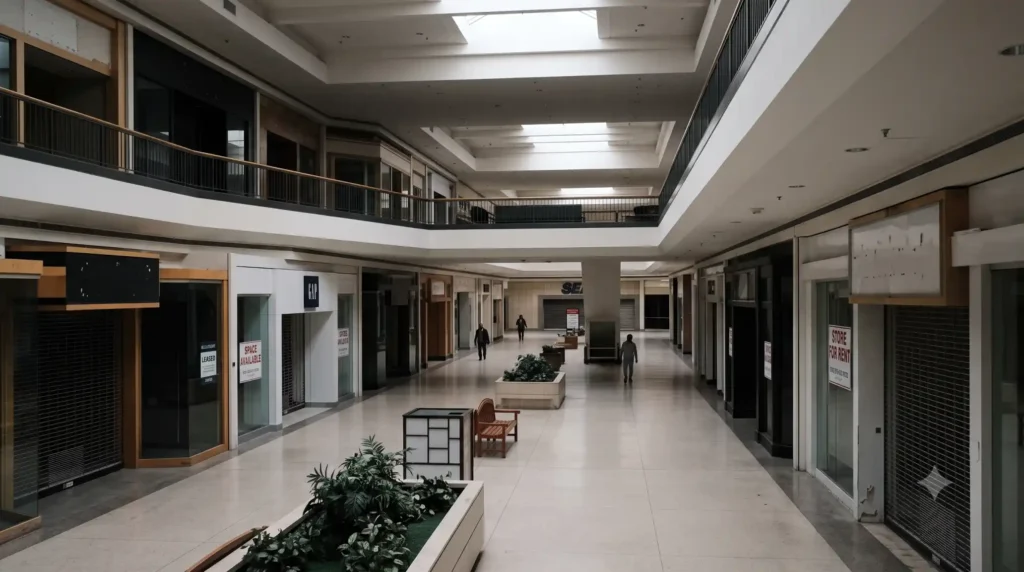
Shopping malls were once the beating heart of American consumer culture. They were places where teenagers hung out on weekends, families spent entire afternoons browsing, and communities gathered around food courts and movie theaters.
Today, that picture has changed dramatically. Across the United States, once-thriving shopping centers sit half-empty. Their parking lots are cracked and overgrown, while their corridors echo with the footsteps of the few shoppers who still visit.
So, why are shopping malls dying? The answer is more complicated than simply blaming Amazon.
The Oversupply Problem
One of the biggest problems facing American malls is that there are simply too many of them. The United States has historically maintained far more retail space per person than any other major economy, with nearly 23 square feet per person. For decades, developers kept building, confident that consumer spending would keep pace. It didn’t.
As of 2025, roughly 1,200 malls remained operational across the country. Industry projections suggest that number could fall to around 900 by 2028. The math is simple. Fewer malls are needed because fewer shoppers are visiting them regularly.
Anchor Stores Are Disappearing
Traditional malls relied on a simple formula. Major department stores acted as anchors, apparel chains filled the corridors, and shoppers moved through the mall between them.
That formula has largely collapsed.
Anchor tenants such as Sears, Lord & Taylor, and Macy’s have closed hundreds of locations. This has left massive vacant spaces that smaller retailers once depended on to attract customers.
When an anchor store closes, the effect can spread quickly. Shoppers no longer have much reason to walk to that part of the mall. Smaller retailers lose customers and their sales begin to fall. Eventually, some of them close as well.
The result is what is often called a “zombie mall.” The property remains technically open, but occupancy is so low that it becomes extremely difficult for the mall to recover.
The Experience Gap
Here’s the uncomfortable truth that many retailers ignored for too long: malls stopped giving people a strong reason to visit.
As Ward Kampf, president of Northwood Retail, put it, “A lot of stores just grew to grow” without giving shoppers something they couldn’t get online.
E-commerce didn’t just take away some retail sales. It changed what customers expect.
Consumers now expect convenience, a wide selection, and competitive prices. When a mall offers the same mass-market products at higher prices, along with the inconvenience of parking and crowds, the attraction becomes weaker.
The malls that continue to attract people are often the ones offering something different, such as entertainment, dining, luxury shopping, fitness, or community experiences.
The K-Shaped Split: Winners and Losers
Not all malls are dying. The retail landscape has increasingly divided into two very different groups.
Class A malls, which are usually luxury-oriented properties located in affluent areas, are doing relatively well. Roosevelt Field on Long Island, for example, has reported 96% occupancy, with tenants such as Hermès, Rolex, and Armani helping drive sales of roughly $1,250 per square foot.
At the other end of the market, the bottom 350 malls in the country account for just 10% of the sector’s value. These properties face much greater pressure and are more likely to close.
The middle ground is also becoming harder to sustain. Mid-tier malls serving middle-income shoppers are being squeezed from both sides by luxury destinations at the top and convenient strip centers and online shopping at the bottom.
What’s Replacing Dead Malls?
The good news is that many struggling malls are finding new life through adaptive reuse.
Around 40% of empty malls are being repurposed into warehouses, residential housing, or community centers. Others are being transformed into mixed-use developments that combine retail with apartments, offices, restaurants, and entertainment.
The most successful transformations often follow a “live-work-shop-play” model.
Former department store spaces have been converted into medical offices, gyms, and even college classrooms. Traditional food courts are also changing, with some being replaced by full-service restaurants and grocery stores that can bring people back throughout the week.
The Global Picture
Interestingly, the mall crisis is not the same everywhere in the world.
India, for example, is experiencing a more complicated situation. Some older malls in Delhi-NCR and other regions are struggling with high vacancy rates and have been described as “ghost malls.” At the same time, demand for Grade A retail space remains strong in several tier-2 cities.
The difference is partly related to market maturity. India experienced significant mall development during the early 2000s, sometimes without a large enough consumer base to support all of that retail space. However, newer and better-designed malls continue to attract brands and shoppers.
In Spain and Mexico, some struggling malls have survived by repositioning themselves as commercial and service hubs for nearby residential communities. Instead of depending mainly on regional shoppers, these properties are changing their mix of services to better serve people who live nearby.
The Future of Retail Spaces
The mall itself is not necessarily dead. The bigger problem is the generic mall that offers little beyond traditional shopping.
The survivors are likely to be properties that provide experiences, convenience, and a sense of community that online shopping cannot easily reproduce. Grocery-anchored centers, lifestyle destinations with fitness and wellness businesses, and carefully curated luxury properties can continue to attract customers.
For many other malls, however, the transformation is already underway.
The traditional shopping mall, with a large department store at either end and rows of apparel chains in between, is becoming less relevant. What replaces it will depend on whether developers can create spaces that people genuinely want to visit, rather than places designed only for shopping.
Key Takeaway: Shopping malls are struggling because of oversupply, the decline of traditional anchor stores, changing consumer habits, and the growth of e-commerce. The malls that survive will be those that successfully reinvent themselves as destinations for experiences, services, entertainment, food, and community rather than relying only on traditional retail.