
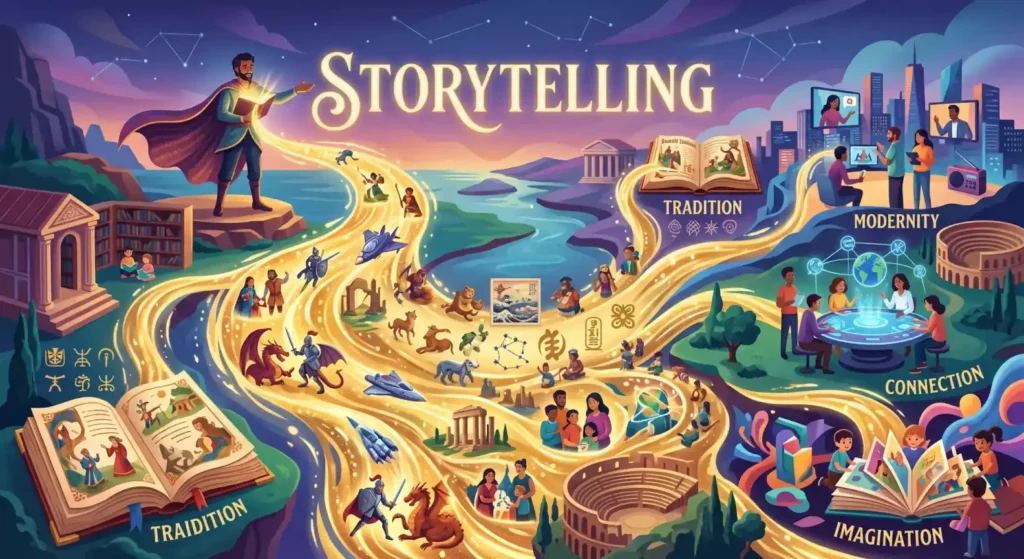
Storytelling is not simply about narrating events. It is about making people feel the journey.
A good story can make us laugh, cry, think, remember something from our own life, and sometimes even look at the world differently. This is probably why stories have always been such an important part of human communication.
We may forget facts and information, but we often remember a story because a story connects with our emotions and imagination.
Why Is Storytelling So Powerful?
Think about the difference between giving advice and telling a story.
If someone simply tells us, “Never give up when you fail,” we understand the message, but we may forget it after some time.
Now imagine someone telling us about a person who failed several times, struggled with self-doubt, almost gave up, and finally achieved something meaningful. The same message suddenly feels much more powerful.
Why?
Because we are not just listening to the message. We are experiencing it through the story.
Storytelling is useful in many areas of life.
In education, stories can make lessons easier to understand and remember. In marketing, brands use stories to connect with people. Leaders often use stories to inspire others. Our own experiences, struggles and failures can also become meaningful stories.
And of course, in film and theatre, storytelling is at the heart of everything.
The 8 Essential Elements of Storytelling
There are many ways of understanding storytelling. Different writers and storytellers follow different approaches.
But if you are just starting to learn storytelling, these eight elements can give you a simple framework to work with.
1. Hook: Grab Attention
The beginning of a story matters a lot.
A good opening makes people curious. It gives them a reason to continue listening or reading.
You can start with a surprising statement, an interesting question, a problem or a moment of tension.
For example:
“That morning, he was certain that his life was about to change.”
Naturally, we want to know what happened.
Why was he so sure?
A good hook creates that kind of curiosity.
2. Character: Give Us Someone to Care About
A story needs someone we can connect with.
The character doesn’t have to be perfect. In fact, imperfect characters are often more interesting because they feel more human.
Their fears, dreams, habits, mistakes, relationships and weaknesses can tell us a lot about them.
We should be able to look at a character and think:
“I understand this person.”
That connection is important.
3. Goal: What Does the Character Want?
Most interesting stories have a character who wants something.
It could be something big or something very simple.
The character may want to achieve something, save someone, overcome a problem, find something, prove themselves, repair a relationship or simply change their life.
The goal gives the story a direction.
Without a clear goal, the audience may start wondering why they should care about what happens next.
4. Conflict: Create a Problem
A story needs problems.
If the character gets everything they want without facing any difficulty, there isn’t much tension.
Conflict can be external or internal.
External conflict could be failure, rejection, financial problems, competition, an accident or another person standing in the character’s way.
Internal conflict can be fear, insecurity, guilt, self-doubt or confusion.
These problems keep the audience interested because they want to know what will happen next.
Will the character overcome the problem?
Will they fail?
What will they do?
These questions keep the story moving.
5. Emotion: Make the Audience Feel
A story can be technically well written and still feel boring if there is no emotion.
We connect with stories when we can feel what the character is going through.
For example, instead of simply writing:
“He was very nervous.”
You could show it:
“His hands were shaking. He looked at the door, took a deep breath and tried to remember his first line.”
The second version allows us to experience the nervousness.
This is one of the basic differences between telling and showing.
A storyteller should not always explain everything to the audience. Sometimes it is better to let the audience experience the emotion themselves.
6. Details: Help Us See the Story
Details help us imagine a scene.
But details should be used carefully. Too few details can make a story feel empty, while too many can make it slow and boring.
The trick is to choose the details that actually matter.
For example, instead of describing an entire room, you might simply write:
“The old clock on the wall had stopped at 11:17.”
That’s enough to create an image in our mind.
It may also make us curious.
Why did the clock stop?
What happened at 11:17?
Sometimes one small detail can do more than a long description.
7. Turning Point: Change the Direction
A turning point is the moment when something changes in the story.
It could be a discovery, a decision, a failure, a realization, a surprise or an unexpected event.
The turning point takes the story in a new direction.
For example, a character might spend the entire story trying to achieve one particular goal. Then they discover that what they really wanted was something completely different.
These moments can make a story memorable.
8. Ending and Message: Leave Something Behind
A good ending is not just about stopping the story.
It should leave the audience with something to think about or feel.
It could be an emotion, a question, an idea or a lesson.
The message doesn’t always have to be explained directly.
Sometimes it is better to let the audience discover it for themselves.
The best stories often stay in our minds even after they are over.
Storytelling Is Also About Delivery
Writing a good story is only one part of storytelling.
When we tell a story to someone, our voice, expressions, pauses and body language can change the entire experience.
A storyteller can use pauses before important moments, changes in voice, different speaking speeds, facial expressions, eye contact, gestures and even silence.
For example, an emotional line doesn’t always become more powerful when it is spoken loudly.
Sometimes a softer voice and a well-timed pause can have a much greater effect.
A good storyteller doesn’t speak every sentence in exactly the same way.
The voice should live with the story.
Common Storytelling Mistakes
Even a good story can lose its impact because of some common mistakes.
Starting with too much information
Don’t spend too much time explaining before something interesting happens.
Give the audience a reason to become curious.
Forgetting conflict
A story without obstacles can quickly become uninteresting.
Give your character something to struggle with.
Adding unnecessary details
Not every detail needs to be included.
If a detail doesn’t add something to the story, the character, the emotion or the situation, you may not need it.
Telling instead of showing
Don’t always explain what a character is feeling.
Whenever possible, show it through actions, expressions and situations.
Having no clear ending
A story doesn’t necessarily need a happy ending.
But it should give the audience some sense of meaning or emotional satisfaction.
You Don’t Need an Extraordinary Life to Tell Great Stories
There is a common belief that you need to have an extraordinary life to tell extraordinary stories.
I don’t think that’s true.
A simple conversation, a childhood memory, a failure, a journey, a mistake, a teacher, a parent, a friendship or even a small incident from an ordinary day can become a good story.
What matters is what you find in that experience.
Two people can experience exactly the same event, but they may understand it in completely different ways.
One person may see nothing special in it. Another person may find a lesson, an emotion or a deeper meaning.
That is what can turn an ordinary incident into a meaningful story.
So storytelling is not only about asking:
What happened?
It is also about asking:
What did it mean?
A Simple Formula to Remember
When you are trying to create a story, ask yourself these eight questions:
1. Hook: Why should people listen?
2. Character: Whose story is this?
3. Goal: What does the character want?
4. Conflict: What is stopping them?
5. Emotion: What should the audience feel?
6. Details: What can help the audience see the scene?
7. Turning Point: What changes everything?
8. Ending: What should the audience remember?
You don’t have to follow these questions like a strict formula every time. But they can be useful when you are developing a story and don’t know where to begin.
Final Thoughts
Storytelling is not about making ordinary life look extraordinary. It is about finding the extraordinary meaning hidden inside ordinary experiences.
A powerful storyteller doesn’t simply tell people what happened. They take the audience on a journey.
They make us see the situation, understand the character, feel the conflict and experience the change.
And when the story ends, something remains with us.
That is the real power of storytelling.
Facts can inform us. Stories can make us feel, remember and understand.
This article was a short course in storytelling, a simple introduction to some of the basic elements that can help you understand, create and tell better stories.
But reading about storytelling is only the beginning.
The real learning starts when you begin observing people, listening to conversations, noticing small incidents and looking at everyday life differently.
A story can be found almost anywhere.
Sometimes it is in a conversation.
Sometimes it is in a failure.
Sometimes it is in a relationship.
And sometimes it is in something that happened on an ordinary day that we almost forgot.
Storytelling is a skill we develop by listening, observing, experiencing and telling stories again and again.
And sometimes, a simple story told with honesty, emotion and meaning can stay with someone for a lifetime.