
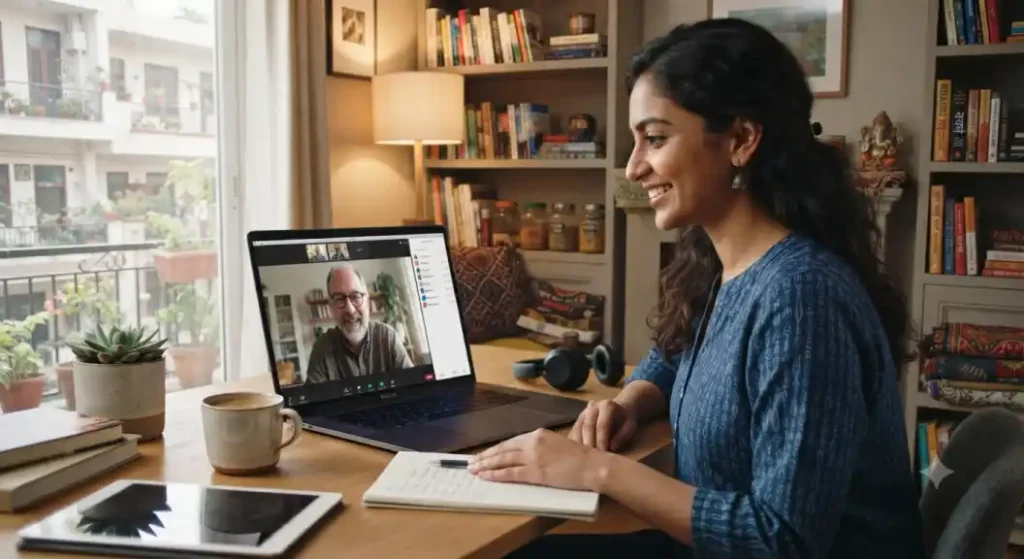
I have been teaching for many years, and during this journey I have taught students in groups, batches, and one-on-one sessions.
I have taught different subjects and skills, including filmmaking, voiceover, communication skills, and story and screenplay writing. I am also a writer, so teaching writing has been a natural part of my journey.
Having worked with students in different learning environments, I have had the opportunity to observe how differently people learn.
One thing I have noticed over the years is that students who learn one-on-one often make more focused progress than students learning in groups or large batches.
This is not something I am saying based on a theory or a book. It is simply an observation from my own experience as a teacher.
My Experience with Groups, Batches and One-on-One Classes
Teaching a group and teaching one student are two very different experiences.
In a group or batch, the teacher has to work with students who may have very different levels of understanding, different abilities, different personalities, and different learning speeds.
Some students understand a concept quickly. Others may need more explanation. Some are confident and participate actively, while others are quiet and may hesitate to ask questions.
The teacher has to manage all of them within the same class and within a limited amount of time.
In a one-on-one class, the situation is completely different.
The teacher’s attention is focused on one person. The lesson can move according to that student’s understanding, and the teacher can spend more time on the areas where the student needs help.
This difference may look small, but in my experience it can have a considerable effect on learning.
How COVID Changed Online Learning
The way people learn has also changed significantly during and after COVID.
Before COVID, online learning was available, but many people were still more comfortable attending physical classes.
During the pandemic, online teaching became a necessity. Teachers and students had to adapt to platforms such as Zoom, Google Meet and other online tools.
Something interesting happened after that.
Even when physical classes became possible again, many students continued with online learning because they had become comfortable with it.
I have seen an increase in students choosing online classes, both in batches and for one-on-one learning.
Online learning also removed one important limitation. A student no longer necessarily has to live in the same city as the teacher.
For many students, this has made personal learning much more accessible.
Why I Feel One-on-One Learning Can Be More Effective
The biggest advantage of one-on-one learning, in my opinion, is personal attention.
When I teach a batch, I have to divide my attention among several students.
Even when I want to give individual feedback to everyone, the available time is limited.
In a one-on-one class, the entire session belongs to one student.
I can listen more carefully, observe the student’s performance, identify specific problems and decide what needs to be worked on during that particular session.
The teaching becomes more responsive to the student.
Every Student Is Different
One of the things I have learned through teaching is that no two students are exactly alike.
Two people may join the same course, but they may have completely different needs.
For example, in voiceover, one student may have a good voice but struggle with pronunciation. Another may pronounce words correctly but lack expression or modulation.
In communication skills, one student may know exactly what they want to say but lack confidence. Another may be confident but need to improve clarity and structure.
In story and screenplay writing, one student may have many ideas but struggle to structure them, while another may understand structure but find it difficult to develop characters or scenes.
These differences are much easier to work with when teaching one student at a time.
Immediate Feedback Matters
For many skills, listening to an explanation is only the beginning.
The student has to actually do the exercise.
Then the teacher has to observe it, give feedback, and allow the student to try again.
I have found this particularly important in creative subjects.
A student can understand the concept of voice modulation, for example, but understanding it intellectually is different from actually applying it while performing.
The same is true for dialogue delivery, communication, storytelling or screenplay writing.
The learning process becomes:
Practice, feedback, correction and practice again.
In a one-on-one session, this process can happen much more frequently.
More Time for Practice
Another difference I have noticed is the amount of individual practice a student gets.
In a batch, the available time has to be divided among everyone.
If ten students need to perform an exercise, each student naturally gets only a portion of the class time.
In a one-on-one session, the student can spend much more time actually doing the exercise.
For practical subjects, I think this is particularly important.
Learning is not only about listening to the teacher. It is about doing, making mistakes and learning from those mistakes.
Students Can Ask Questions Freely
Some students are very comfortable asking questions in a group. Others are not.
I have seen students who remain quiet during a group class even when they have not completely understood something.
There can be many reasons for this. They may feel shy, they may not want to interrupt the class, or they may think their question is too basic.
In a one-on-one session, there is usually much less hesitation.
The student can stop the lesson and ask a question whenever something is unclear.
As a teacher, this also helps me understand exactly where the student is having difficulty.
Learning at the Student’s Pace
A batch generally has to follow a particular schedule.
If one student needs more time, the entire class cannot always stop for that one person.
In a one-on-one session, the pace can be different.
If something needs more explanation, we can spend more time on it.
If the student understands something quickly, we can move forward.
For me, this is one of the important differences between teaching a group and teaching an individual.
The objective should not simply be to finish a syllabus.
The real objective should be to make sure that the student understands what is being taught and can actually use it.
Why Many Teachers Prefer Batches
There is also a practical side to one-on-one teaching that is worth discussing.
A teacher has only a limited number of hours in a day.
If a teacher teaches one-on-one, they can personally coach only a limited number of students.
For example, if each student requires one hour, there is a natural limit to the number of students the teacher can teach in a day.
A batch is different. The same one or two hours can be used to teach many students at the same time.
From a professional and financial point of view, this makes batch teaching more practical for many teachers.
This may be one reason why relatively few teachers choose to spend most of their teaching time on one-on-one classes.
It does not necessarily mean that teachers do not value personal coaching.
It is simply a question of time, capacity and economics.
For the student, however, that one hour of personal teaching means that the teacher’s attention is dedicated entirely to them.
What I Have Personally Observed
After teaching both groups and individuals for many years, I have personally seen many one-on-one students make good progress.
They often become more comfortable asking questions, receive more direct feedback, and get more opportunities to practice.
I have also noticed that individual teaching can help a teacher understand a student’s personality and learning style better.
This does not mean that group learning is ineffective.
It certainly is not.
Group classes have their own advantages.
Students can interact with one another, listen to different opinions, observe other students, learn from their mistakes and sometimes even gain confidence by working together.
For some students, a group environment may actually suit them very well.
But when the objective is focused skill development and individual improvement, I have found one-on-one learning particularly useful.
My Experience with Creative Subjects
Much of my teaching has been connected with creative and communication-based subjects.
Voiceover, communication skills, filmmaking, and story and screenplay writing all require practice and individual feedback.
There is no single formula that works equally well for everyone.
A person’s voice is different.
A person’s way of communicating is different.
A person’s imagination and way of telling a story are different.
This is why I feel that teaching creative skills requires some understanding of the individual student, rather than simply following a fixed lesson plan.
One-on-One Learning Does Not Guarantee Success
I also want to make one thing clear.
One-on-one learning does not automatically guarantee success.
The teacher can provide guidance, exercises, feedback and direction, but the student still has to put in the effort.
A student who does not practice will not improve simply because the class is one-on-one.
What one-on-one learning provides is an environment where the teacher can give more focused attention and the student gets more opportunities to practice and receive individual feedback.
What the student does with that opportunity is equally important.
Final Thoughts
After teaching students in groups, batches and one-on-one sessions for many years, I have developed a strong appreciation for personal learning.
The biggest difference, in my experience, is simple.
A group class has to accommodate the group. A one-on-one class can accommodate the individual.
The growth of online education during and after COVID has made both group learning and personal learning much more accessible.
Students can now learn from teachers who may be in another city or even another country. At the same time, teachers can reach students without the limitations of a physical classroom.
But there is still something special about teaching one person at a time.
The teacher can listen more carefully.
The student can ask more freely.
The lessons can move at the student’s pace.
Mistakes can be identified immediately.
And there is more time for actual practice.
From what I have personally seen during my years of teaching, these things can make a meaningful difference.
Every student is different. Perhaps that is why there can never be one single way of teaching that works equally well for everyone.
Sometimes, the best way to teach is simply to give one student your complete attention.