
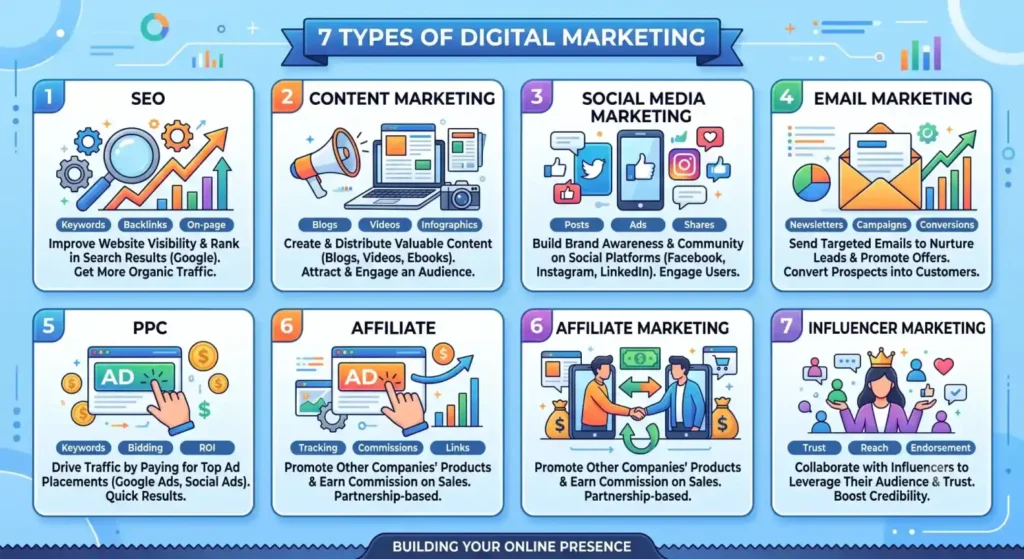
Digital marketing has become an important part of growing any business online. Whether you run a small business, offer professional services, sell products, or manage a large company, digital marketing helps you reach potential customers, build brand awareness, and generate leads.
There are several types of digital marketing, and each one serves a different purpose. Some help your website appear on Google, while others help you connect with customers through social media, email, videos, and paid advertisements.
In this article, we will explore 7 types of digital marketing, how they work, and how businesses can use them to improve their online presence.
1. Search Engine Optimization (SEO)
Search Engine Optimization, commonly known as SEO, is the process of improving a website so that it can appear higher in search engine results.
When someone searches for a product, service, or information on Google, they usually visit websites that appear relevant to their search. SEO helps businesses improve their visibility in these search results and attract visitors without paying for every click.
SEO generally involves three main activities:
- On-page SEO: Optimizing website content, page titles, headings, URLs, internal links, and images.
- Off-page SEO: Building relevant backlinks, earning brand mentions, and improving website authority.
- Technical SEO: Improving website speed, mobile usability, indexing, site structure, and technical performance.
For example, if you run a photography studio in Mumbai, you may want your website to appear when people search for photography studios or modeling portfolio photographers in Mumbai.
SEO is a long-term marketing activity. It usually takes time to see meaningful results, but a well-optimized website can continue attracting relevant visitors over time.
2. Social Media Marketing (SMM)
Social Media Marketing involves promoting a business, product, or service through social media platforms such as Instagram, Facebook, LinkedIn, YouTube, and Pinterest.
Social media is not just a place to post photographs or share updates. Businesses can use it to communicate with customers, demonstrate their expertise, answer questions, promote offers, and build a recognizable brand.
Some common social media marketing activities include:
- Publishing regular posts, photographs, and videos.
- Creating reels and short-form video content.
- Sharing customer experiences and business updates.
- Responding to comments and direct messages.
- Running paid social media campaigns.
- Collaborating with relevant creators and influencers.
For example, a restaurant can share food photographs, customer experiences, special menus, and behind-the-scenes videos. A coaching institute can publish educational content, student projects, and course information.
The important thing is to choose platforms that match your audience and business objectives. Being active on every social media platform is not necessary.
3. Content Marketing
Content Marketing is the process of creating and distributing useful, relevant, and informative content to attract and engage a target audience.
Instead of directly promoting a product in every message, content marketing focuses on answering questions, solving problems, and providing information that people are already looking for.
Common forms of content marketing include:
- Blog articles and guides.
- Educational videos and tutorials.
- Infographics and visual explanations.
- Case studies and research reports.
- E-books and downloadable resources.
- Frequently asked questions and how-to articles.
For example, a digital marketing agency can publish articles about SEO, website development, Google Ads, and social media strategies. People searching for these topics may discover the agency through its content.
Content marketing also supports SEO because informative, well-structured articles can help search engines understand a website and its subject matter.
However, publishing a large number of articles is not enough. Content should be accurate, original, easy to understand, and genuinely useful to the intended audience.
4. Search Engine Marketing (SEM) and Paid Advertising
Search Engine Marketing, particularly paid search advertising, helps businesses appear in sponsored search results when people search for relevant products or services.
Google Ads is one of the most widely used platforms for this type of marketing. Businesses can create advertisements that target specific search terms, locations, audiences, and other criteria.
For example, a person searching for an online photography course may see an advertisement from a photography training institute.
Paid search marketing commonly involves:
- Keyword research and selection.
- Writing relevant advertisements.
- Setting daily or campaign budgets.
- Choosing locations and target audiences.
- Creating landing pages.
- Tracking clicks, leads, conversions, and costs.
One of the main advantages of paid search advertising is that it can reach people who are actively searching for something. Businesses can also adjust campaigns based on performance.
However, paid advertising requires careful budget management. If advertisements attract visitors who are unlikely to become customers, the business may spend money without generating meaningful results.
SEM can also be used as a broader term for search marketing that includes both organic and paid search activities, although it is often used specifically for paid search advertising.
5. Email Marketing
Email Marketing is the process of communicating with potential and existing customers through email.
It is useful for businesses that want to maintain relationships with their audience, share updates, promote products, and encourage repeat purchases.
Unlike social media, where the platform controls much of the distribution, email allows businesses to communicate directly with people who have chosen to receive their messages.
Some common email marketing activities include:
- Sending newsletters.
- Sharing product announcements.
- Offering discounts and special promotions.
- Sending educational information.
- Following up with prospective customers.
- Sending reminders and customer updates.
For example, an online course provider can send emails about upcoming batches, new course modules, free learning resources, and enrollment deadlines to people who have subscribed to its mailing list.
Successful email marketing depends on sending relevant messages at an appropriate frequency. Businesses should also obtain proper consent, provide a clear unsubscribe option, and respect applicable privacy and marketing regulations.
6. Video Marketing
Video Marketing involves using videos to promote a business, explain products and services, educate audiences, and build trust.
Video is particularly useful when a business needs to demonstrate something that may be difficult to explain through text alone.
Businesses can publish videos on YouTube, Instagram, Facebook, LinkedIn, and their own websites.
Popular forms of video marketing include:
- Product demonstrations.
- Educational videos and tutorials.
- Customer testimonials.
- Interviews and expert discussions.
- Behind-the-scenes videos.
- Short promotional videos and reels.
- Webinars and recorded presentations.
For example, a filmmaking academy can publish videos explaining camera techniques, lighting, screenplay writing, editing, and filmmaking careers. These videos can help prospective students understand the academy’s teaching approach and course offerings.
Video marketing can support other digital marketing activities as well. A video can be embedded in a blog article, shared through social media, or included in an email campaign.
The focus should be on clear communication and useful information rather than expensive production alone.
7. Affiliate and Influencer Marketing
Affiliate Marketing and Influencer Marketing both involve promoting products or services through other people, but they work in different ways.
Affiliate Marketing is a performance-based marketing model in which an affiliate promotes a company’s products or services and earns a commission when qualifying sales, leads, or other agreed actions occur.
For example, a blogger who writes about cameras may include affiliate links to photography equipment. If readers purchase products through those links, the blogger may earn a commission.
Influencer Marketing involves collaborating with content creators who have an audience on platforms such as Instagram, YouTube, or other social networks. Businesses may pay influencers or provide other agreed benefits in exchange for content promoting their products or services.
For example, a skincare brand may collaborate with a beauty creator who produces a product demonstration or review for their audience.
Both approaches can help businesses reach people through established content creators and relevant communities.
However, businesses should evaluate audience relevance, engagement quality, campaign costs, and actual results. Paid partnerships and affiliate relationships should also be disclosed clearly in accordance with applicable advertising guidelines.
Which Type of Digital Marketing Should a Business Use?
There is no single digital marketing method that works for every business. The right approach depends on the target audience, available budget, business model, competition, and marketing objectives.
Here is a simple comparison:
| Type | Main purpose | Common use |
|---|---|---|
| SEO | Improve organic search visibility | Attract people searching for relevant information or services |
| Social Media Marketing | Build awareness and engagement | Connect with audiences and share regular updates |
| Content Marketing | Educate and attract an audience | Publish articles, guides, videos, and resources |
| Paid Search Advertising | Reach people through sponsored search results | Generate targeted website visits and leads |
| Email Marketing | Maintain customer relationships | Share updates, offers, and useful information |
| Video Marketing | Explain and demonstrate through video | Build understanding, engagement, and trust |
| Affiliate and Influencer Marketing | Reach audiences through partners and creators | Promote products and services through third parties |
A small business with a limited budget may begin with a well-structured website, local SEO, and useful social media content. A business that needs leads quickly may also consider paid advertising. An established business with an existing customer database may benefit from email marketing and customer retention campaigns.
The best starting point is to identify the business objective first, then select the marketing methods that support it.
What Are the New Types of Digital Marketing Emerging Today?
Digital marketing is continuously evolving with the growth of artificial intelligence, automation, and new online platforms. Some emerging approaches include AI-powered marketing, where businesses use AI tools to create content, analyze customer behavior, personalize communication, and automate marketing tasks. Generative Engine Optimization (GEO) is another developing area that focuses on making business information easier for AI-powered search engines and chatbots to understand, reference, and recommend. Conversational marketing uses AI chatbots and messaging platforms to answer customer questions and support enquiries in real time. Voice search optimization focuses on making information accessible to people using voice assistants, while hyper-personalized marketing uses customer data and automation to deliver more relevant experiences. These approaches are expanding the possibilities of digital marketing, and businesses can explore them alongside traditional methods as technology and customer behavior continue to change.
Final Thoughts
Digital marketing is a combination of different strategies that help businesses build their online presence, reach potential customers, and grow over time. From SEO and content marketing to social media, paid advertising, email campaigns, and video marketing, each method serves a different purpose.
With the emergence of AI-powered marketing, Generative Engine Optimization (GEO), conversational marketing, and automation, businesses now have more ways to connect with their audiences and improve their digital visibility.
However, success does not depend on using every marketing technique. It depends on choosing the right strategies, understanding customer needs, creating useful content, and regularly measuring results. A well-planned digital marketing approach can help businesses remain visible, relevant, and competitive as the online landscape continues to evolve.