
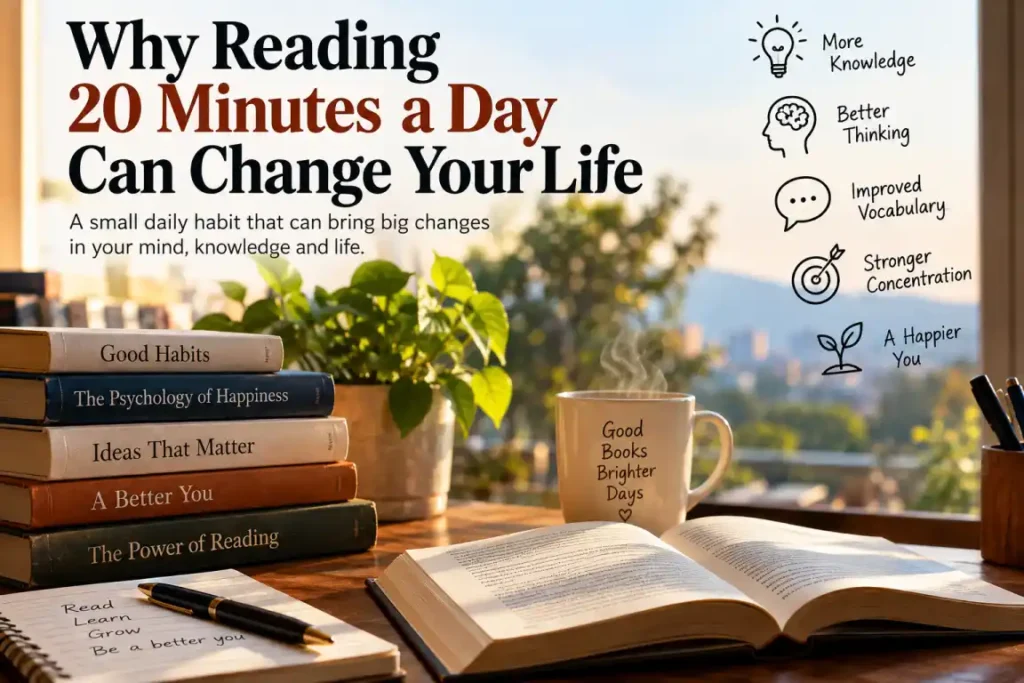
We often think that changing our life requires doing something big. We make ambitious plans, set difficult goals, and promise ourselves that from tomorrow everything will be different.
But sometimes a very small habit can quietly make a big difference.
Reading for just 20 minutes every day is one of those habits.
You do not have to finish a book every week. You do not need to read hundreds of pages. You simply need to find a comfortable place, open a good book, and give yourself twenty minutes.
Over time, those twenty minutes can improve your knowledge, vocabulary, concentration, imagination, and even the way you think.
You Start Learning Something Every Day
One of the greatest benefits of reading is simple: you keep learning.
Every book contains someone else’s knowledge, experience, ideas, research, or imagination.
When you read a biography, you learn from another person’s life. When you read history, you understand how people and societies changed. A business book can introduce you to new ideas about money and work. A novel can show you human emotions and relationships from a completely different point of view.
You may learn only one small thing during your twenty minutes of reading.
But imagine learning something new almost every day for a year.
That knowledge slowly becomes part of you.
Your Vocabulary Naturally Improves
You do not always need to memorize long lists of words to improve your vocabulary.
Reading can do it naturally.
When you regularly see new words in sentences, you begin to understand how those words are actually used. Some words may be unfamiliar the first time you see them. After seeing them several times, their meaning becomes clearer.
Gradually, you start using better words while speaking and writing.
This is particularly useful for students, writers, teachers, professionals, public speakers, and anyone who wants to communicate more clearly.
Reading Trains Your Concentration
Today, our attention is constantly being interrupted.
A message arrives. A notification appears. We check social media. Then we watch a short video. Before we realize it, we have moved from one thing to another several times.
A book asks us to do something different.
It asks us to stay with one idea.
When you read continuously for twenty minutes, you are training your mind to remain focused on one activity. In the beginning, you may feel tempted to check your phone after five minutes. But with regular practice, staying focused becomes easier.
Reading is almost like exercise for your attention.
It Makes You Think
A good book does more than give you information.
It makes you ask questions.
Why did this person make that decision?
Do I agree with the author?
What would I have done in the same situation?
Could there be another explanation?
These questions develop thinking.
This becomes even more interesting when you read books written by people whose experiences or opinions are different from your own. You begin to understand that the same situation can sometimes be seen from several different angles.
Reading does not simply fill your mind with information. Good reading teaches you to examine information.
Books Improve Your Imagination
When you watch a film, much of the imagination has already been done for you.
You can see the actor, house, street, clothes and expressions.
A book works differently.
If a writer says that a man entered an old abandoned house on a rainy night, your mind begins creating the scene. You imagine the house, the rain, the darkness and perhaps even the sound of his footsteps.
Your brain becomes part of the storytelling process.
This is one reason reading fiction can be such a powerful creative exercise.
You Begin to Understand People Better
Books allow us to enter lives that we may never experience ourselves.
A novel may put you inside the mind of someone living in another country or another century. A biography may show you the struggles behind a successful person’s public image. A memoir may help you understand an experience completely different from your own.
This can develop empathy.
You begin to understand that people have their own fears, hopes, problems, motivations and histories.
And understanding people better can also improve the way we communicate and build relationships.
Twenty Minutes Is Easier Than It Sounds
People often say, “I don’t have time to read.”
That may genuinely feel true.
But twenty minutes is a relatively small part of the day.
You could read for ten minutes in the morning and ten minutes before sleeping. You could read during a train journey, while waiting for an appointment, during a lunch break, or instead of spending twenty minutes scrolling through your phone.
The goal is not to read quickly.
The goal is to read regularly.
Even if you read only 10 pages a day, that becomes around 3,650 pages in a year. Depending on the length of the books you choose, that could mean finishing roughly 10 to 15 books.
That is a lot of reading from one small daily habit.
Don’t Turn Reading Into a Competition
There is another important point.
You do not have to read what everyone else is reading.
Choose books that genuinely interest you.
Read novels if you enjoy stories. Read biographies if you like real lives. Read psychology, history, science, philosophy, business, poetry, travel or anything else that makes you curious.
And if a book is not working for you, it is perfectly reasonable to put it aside and try another one.
Reading should not feel like punishment.
A good book should make you want to return to it.
How to Build a 20-Minute Reading Habit
Start small.
Choose one book and keep it somewhere you can easily see it. Decide on a regular time, such as after breakfast or before going to bed. Put your phone away and read without interruption.
Do not worry about how many pages you complete.
Some books require slow reading. Others can be read quickly.
What matters is showing up again tomorrow.
Twenty minutes today.
Twenty minutes tomorrow.
Then again the next day.
A Small Habit With a Big Return
Reading for twenty minutes will not transform your life overnight.
You may not notice anything remarkable after the first week.
But that is how many useful habits work.
Their effects accumulate quietly.
One book introduces you to an idea. Another changes your opinion about something. A sentence stays in your mind. A story helps you understand someone better. A new word enters your vocabulary. Your concentration becomes a little stronger.
Months later, you may realize that you know more, think differently, communicate better, and have become curious about things you had never considered before.
All because you regularly opened a book.
So instead of promising yourself that you will “read more someday,” try something simpler.
Read for twenty minutes today.
Then do it again tomorrow.
A small daily reading habit may eventually become one of the most valuable habits you ever develop.