
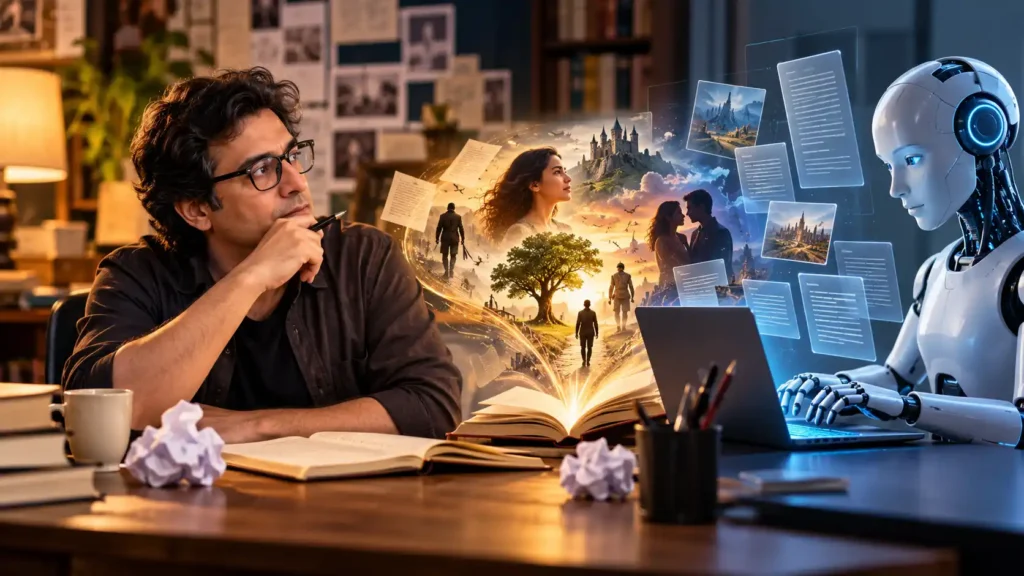
Artificial Intelligence has changed the way we work, communicate and create content. Today, AI can write articles, poems, scripts, stories and even dialogues within seconds. This naturally raises an interesting question: Can AI replace story writers?
In my opinion, AI can become a very useful tool for a story writer, but I don’t think AI can completely replace a good human storyteller.
Story writing is not only about putting words together. A good story comes from observation, imagination, emotions, experiences and an understanding of human nature. These are the things that make a story feel real.
AI Can Write a Story, But Can It Feel the Story?
AI can analyse thousands of stories and learn different writing patterns. If we give AI a prompt, it can create a story with characters, conflict, emotions and even a surprise ending.
But there is a difference between creating a story and experiencing a story.
A writer has lived through different situations in life. Love, disappointment, friendship, failure, success, loneliness, fear and happiness can all become part of a writer’s imagination.
When a writer writes about heartbreak, for example, the story may come from something the writer has personally experienced or observed in someone else.
AI does not live that life.
It can understand the concept of sadness from the information it has learned, but human emotions are much deeper than information.
A Writer Observes People
I believe one of the most important qualities of a story writer is the ability to observe people.
Every person has a story.
The way someone talks, walks, reacts to an unexpected situation or hides an emotion can become an idea for a character.
A writer sitting in a café, travelling in a train or simply watching people on the street can notice small things that can later become part of a story.
This kind of observation is not always something that can be learned from data.
A human writer can ask:
Why did this person behave like that?
What might be happening inside this character?
What is the character hiding from others?
These questions can lead to interesting stories.
Then What Can AI Do for Writers?
This does not mean that I am against AI. On the contrary, I think AI can be an excellent assistant for writers.
A writer can use AI to develop an idea, create different situations, brainstorm characters, find possible plot directions or improve the structure of a story.
For example, if I have an idea about a character who discovers an old secret after many years, I can discuss that idea with AI and ask it to suggest different possibilities.
But I would still want to decide which direction the story should take.
The final creative decision should belong to the writer.
AI Can Save Time
There is another major advantage of AI.
Writing sometimes involves a lot of repetitive work. A writer may spend hours trying to find the right structure or rewrite the same scene again and again.
AI can help speed up this process.
It can suggest alternative dialogues, rewrite a paragraph, create a basic outline or help identify weaknesses in a story.
This allows the writer to spend more time on the most important part ; creativity.
I see AI more as a creative assistant than a replacement.
What Makes a Great Story?
A great story is not necessarily the story with the most complicated plot.
Sometimes a simple story can touch millions of people.
Why?
Because people see a part of themselves in it.
A good writer understands human emotions. The writer knows what people fear, what they desire, what they hide and what they dream about.
Technology can help us produce content faster, but storytelling is ultimately about connecting with another human being.
That human connection is very difficult to replace.
Will AI Replace Some Writers?
Having said that, I do believe AI will change the writing profession.
Some types of writing may become highly automated. Basic content, repetitive stories, simple descriptions and formula-based writing can increasingly be produced with AI.
Writers who only depend on producing predictable content may face competition from AI.
Therefore, writers will have to develop something more valuable ; their own voice, imagination and point of view.
A writer who has a unique way of looking at the world will always have an advantage.
The Future May Be Human + AI
I don’t think the future is going to be a battle between humans and AI.
I think the future will be about humans using AI intelligently.
A talented writer with a good AI tool may be able to work faster and explore more ideas than a writer working without any technological assistance.
But the writer will still need to provide the vision.
AI can give me ten ideas.
I have to decide which one is worth telling.
AI can write a scene.
I have to decide whether that scene has emotion.
AI can create a character.
I have to make that character believable.
And most importantly, I have to know why I am telling the story in the first place.
My Conclusion
So, can AI replace story writers?
I don’t think it can replace good story writers completely.
AI can write. It can analyse. It can generate ideas. It can imitate different writing styles and help writers work faster.
But storytelling is more than writing.
It is about observing life, understanding people, imagining possibilities and connecting emotionally with an audience.
As long as human beings continue to experience love, loss, happiness, fear, ambition, failure and hope, there will be a need for people who can turn those experiences into stories.
For me, AI is not the end of storytelling.
It is a new tool in the hands of storytellers.
The writers who learn how to use that tool without losing their own voice may be the ones who tell the most interesting stories of the future.