
When Silence Speaks by Ankita Dhar
The first time I watched Barfi!, I paid attention to the actors, the locations, and the way the story unfolded. I admired the performances and noticed how beautifully the characters expressed themselves, often without relying on dialogue. I was enjoying what I saw on the screen, quietly observing how a film could communicate so much through its images and performances.
But one moment stayed with me.
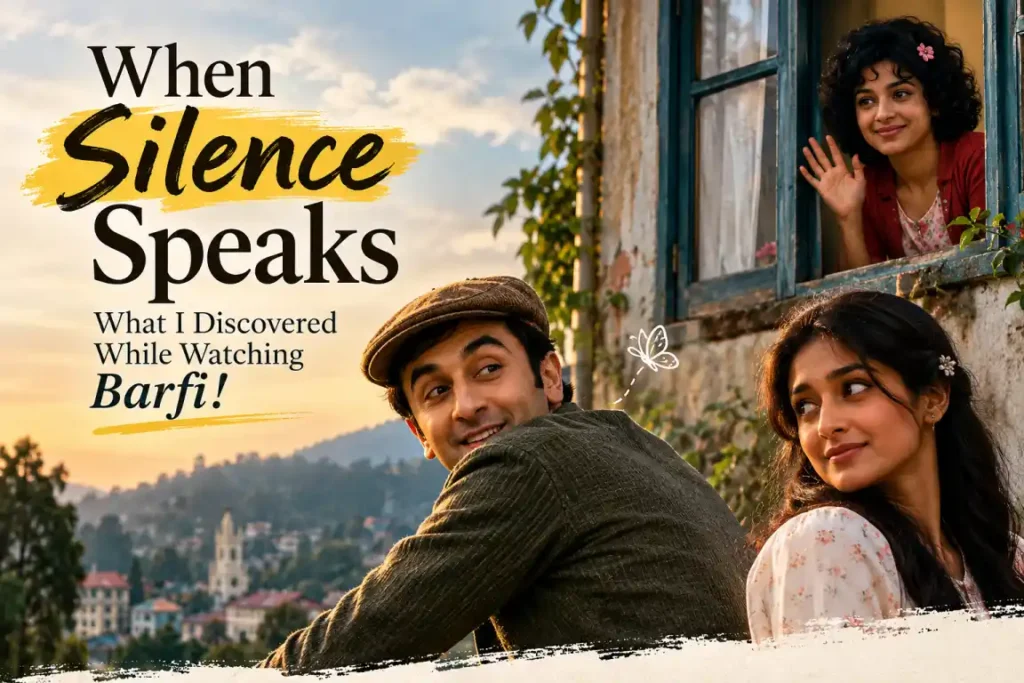
Near the end of the film, Barfi is walking away with Shruti when Jhilmil calls out to him from a window. Barfi cannot hear her, but Shruti can. She has a choice: remain silent and continue walking with the man she once loved, or let him know that Jhilmil is calling him.
Shruti chooses to signal to Barfi.
Why does she do that when staying silent could give her another chance at the life she once wanted with him?
I do not think I had a clear answer to that question when I first watched the film. But the question stayed with me, and perhaps that is what makes certain films worth returning to.
Sometimes, we do not understand everything we see the first time. A moment remains somewhere in our minds until life gives us another way to look at it.
Over time, as I have observed people and the world around me, I have begun to appreciate how much can be communicated without words. An expression, a pause, a gesture, or the way someone looks at another person can reveal something that a conversation might struggle to explain.
Earlier, I used to think that expressing emotions without words must be difficult. How could someone make another person understand what they felt without explaining it?
Now, I feel that perhaps we do it more often than we realise. We notice expressions every day, even when we are not consciously trying to understand them. We observe how people behave, remember their reactions, and sometimes discover the meaning of a moment much later.
Perhaps that is one of the things cinema teaches us. A character does not always need to explain everything. Sometimes, the way a person behaves, the moment they choose to speak, or the moment they choose not to speak gives us more to think about than a long conversation.
Of course, silence does not always have one meaning. It can suggest love, fear, hesitation, patience, or uncertainty. An expression can also be misunderstood. What matters is not simply observing a person, but being willing to consider what we might not yet understand.
And perhaps we do the same thing in our own lives. We interpret people’s actions, make assumptions about their feelings, and sometimes discover that our understanding was incomplete.
That is why I would encourage anyone watching Barfi! to pay attention not only to the story but also to the moments that remain with them afterwards. Ask yourself why a character made a particular choice, what remained unsaid, and whether your understanding of that moment changes with time.
You might discover an answer hidden in the story that connects with a question you are facing in your own life.
Maybe the film has not changed. Maybe the way we see it has.
Three Characters, Three Lessons in Screenwriting
Beyond its emotional story, Barfi! offers valuable lessons for anyone interested in filmmaking, storytelling, or screenplay writing. Through Barfi, Jhilmil, and Shruti, we can explore three important aspects of storytelling: physical expression, perspective, and subtext.
1. Barfi — Expressing Without Words
Played by Ranbir Kapoor
Barfi is playful, mischievous, expressive, and emotionally engaging. He is a hearing- and speech-impaired character whose actions, gestures, and expressions carry much of the storytelling.
What makes his character interesting is not simply the absence of spoken dialogue. It is the way his physical behaviour becomes an essential part of how the audience understands him.
As a writer, pay attention to three things:
- Facial expressions and body language: Notice how Barfi communicates his feelings through movement, gestures, and reactions.
- The role of humour: Observe how physical comedy changes the atmosphere of a scene and sometimes makes an emotional moment even more powerful.
- Actions that reveal character: Consider how Barfi’s behaviour can communicate something different from what other characters expect of him.
These choices remind us that a character can remain expressive and emotionally engaging without explaining every feeling through words.
The deeper question is this: Do we really need words to understand someone, or have we simply become too dependent on them?
We do not always need words to understand another person, but we should not confuse observation with certainty. Expressions can mislead, and silence can mean different things in different situations.
Sometimes, understanding begins with noticing rather than speaking. It also requires the patience to listen, observe, and recognise that our first interpretation may not be correct.
For a screenwriter, Barfi offers an important lesson: physical behaviour is not merely an addition to dialogue. It can be storytelling in itself.
A glance, a hesitation, a movement towards someone, or an attempt to hide an emotion can tell the audience something that a line of dialogue might weaken by explaining too clearly.
The filmmaker’s task is not to explain every emotion but to create moments in which the audience can feel and interpret what is happening.
2. Jhilmil — A World Others May Not Understand
Played by Priyanka Chopra Jonas
Jhilmil is an autistic character whose way of communicating and relating to others is central to her story. Through her, the film invites us to consider how easily people can misunderstand someone whose behaviour differs from their expectations.
As writers, we can learn several things from her character:
- Observe individual behaviour: Notice how Jhilmil responds to different people and situations.
- Examine other characters’ assumptions: Consider how the people around her interpret her actions and whether those interpretations are accurate.
- Distinguish outward behaviour from inner experience: Remember that what a person shows on the outside does not necessarily reveal everything they feel or think.
The deeper question is this: How often do we misunderstand someone simply because they do not express themselves in the way we expect?
We often judge people by their behaviour without making an effort to understand their perspective. We may assume that someone is uninterested, unfriendly, confused, or indifferent when we do not fully understand what they are experiencing.
But people do not all communicate or experience the world in the same way. There is no single expression or behaviour that tells us exactly what another person feels.
Jhilmil’s character reminds us that understanding someone begins when we become curious about their perspective instead of expecting them to respond as we would.
She should not be reduced to a mystery for other characters to solve. She has her own feelings, preferences, attachments, and choices. Her character matters in her own right, not simply because other people struggle to understand her.
This is an important lesson for screenwriters. When writing a character whose experiences differ from our own, we should look beyond the assumptions of the surrounding characters and consider the character’s own point of view.
A well-developed character is more than the way other people see them. They have an inner life, personal motivations, and reasons for acting as they do, even when the audience does not immediately understand those reasons.
3. Shruti — The Person Who Understands, but Must Choose
Played by Ileana D’Cruz
Shruti offers another perspective on love, regret, and difficult decisions. Her character reminds us that understanding a situation and deciding what to do about it are two different things.
Her choices throughout the film are shaped by her feelings, her circumstances, and the expectations placed upon her. She loves Barfi, but she also struggles with the practical and social concerns that influence her decisions.
Her final choice to signal to Barfi when Jhilmil calls him is especially revealing.
Shruti could remain silent. She could continue walking with Barfi and hold on to the possibility of being with him. Instead, she lets him know that Jhilmil is there.
The moment is powerful because Shruti’s action goes against what she might personally want. She recognises where Barfi’s heart belongs, even though accepting that reality means giving up the future she once imagined with him.
What should we observe as writers?
- The difference between feelings and decisions: A character may love someone and still make choices that take them in another direction.
- The information a character possesses: Consider what the character knows at a particular moment and how that knowledge influences their actions.
- The consequences of a choice: Examine what the character gains, what they lose, and what their decision reveals about them.
The deeper question is this: Is understanding a situation enough, or does understanding sometimes require us to make a difficult choice?
Understanding something is one thing; deciding what to do with that understanding is another.
Sometimes, we recognise the truth but remain silent because speaking might change a relationship, hurt someone, or force us to accept something we are not ready to face. We tell ourselves that we understand both sides, that we do not want to interfere, or that perhaps time will solve everything.
But beneath those reasons, there may be a choice we are afraid to make.
The moment we act on what we understand, we can no longer pretend that we did not know.
What Is the Subtext?
In screenwriting, subtext is the meaning beneath what a character says or does. It is what the audience senses without the character necessarily expressing it directly.
Shruti’s final decision can be understood through several layers of subtext:
- She understands: She recognises that Barfi’s emotional attachment to Jhilmil remains powerful.
- She could remain silent: Silence would give her a chance to continue the relationship she wants, but it would mean withholding something important from Barfi.
- She chooses to signal: Her action allows Barfi to respond to Jhilmil’s call, even though it may cost Shruti the future she hopes for.
- She accepts the consequences: By making her choice, Shruti acknowledges a reality she cannot change simply by wishing it were different.
This is what makes the scene more than a simple romantic moment. It places Shruti between personal desire and the recognition of someone else’s feelings.
The scene also challenges the comfortable idea that understanding automatically makes us wise or courageous. We can understand why someone behaves a certain way and still struggle to decide whether to stay. We can understand both sides of a conflict and still have to choose what we believe is right.
We can even understand our own feelings and remain afraid to express them.
The tension lies in the distance between what we know and what we do.
Most people can recognise that distance in their own lives, which makes the question personal rather than merely philosophical.
How Can Screenwriters Use This Technique?
Imagine a scene in which a character knows that a relationship is ending but cannot bring themselves to say it.
Instead of having the character explain their feelings, show them preparing tea, checking their phone, rearranging objects on a table, or repeatedly changing the subject.
The audience begins to notice a pattern. The character appears occupied, but their behaviour suggests avoidance. Every small action delays the conversation they know they must have.
The character’s struggle is no longer expressed through an explanation. It becomes visible through behaviour.
That is the power of subtext.
The strongest subtext often lies in the gap between what a character understands and what they are prepared to do about it. The character may not be struggling to discover the truth. They may be struggling with the life that could begin once they acknowledge it.
Shruti’s final decision provides a moving example of how a small gesture can carry the weight of a much larger emotional conflict.
As writers, we should therefore examine not only what a character says, but also what they avoid saying, what they choose to do, and what that choice costs them.
What Barfi! Teaches Us About Visual Storytelling
Looking at these three characters together, we can see how different aspects of storytelling work in combination.
Barfi reminds us that physical behaviour can communicate emotion. Jhilmil encourages us to question our assumptions about other people. Shruti shows us how a character’s decisions can reveal feelings that dialogue alone might not fully express.
These are not separate techniques. They work together.
A character’s expression can suggest an emotion. Their action can reveal a conflict. Their decision can expose a deeper truth about who they are.
The audience does not need every detail explained immediately. In fact, when a film leaves room for observation and interpretation, viewers can become more actively involved in the story.
This does not mean that dialogue is unimportant or that silence is always more powerful than words. The important question is whether each storytelling choice serves the character, the scene, and the emotional experience of the audience.
Sometimes, a single line of dialogue is exactly what a scene needs. At other times, a pause or a small gesture can communicate more effectively.
The skill lies in knowing the difference.
A Final Thought
I began thinking about this article with a simple question: Why did Shruti choose to let Barfi know that Jhilmil was calling him when she could have remained silent?
The more I think about it, the more I realise that the question is not only about Shruti or her decision. It is also about how we interpret people, how we understand their choices, and how our own experiences influence what we see in a story.
A film can offer us one experience when we first watch it and another when we return to it years later. The scenes remain the same, but we bring different questions, memories, and perspectives to them.
That is one of the reasons cinema can stay with us long after the screen goes dark.
So, the next time you watch Barfi!, look beyond the plot. Notice the expressions, the pauses, the gestures, and the moments when a character must choose between what they want and what they believe they should do.
Ask yourself what remains unsaid, what a particular action reveals, and why a moment affects you in a way you did not expect.
You may discover something about the film. You may discover something about storytelling.
Or you may discover something about yourself.
Maybe the film has not changed.
Maybe the way we see it has.