
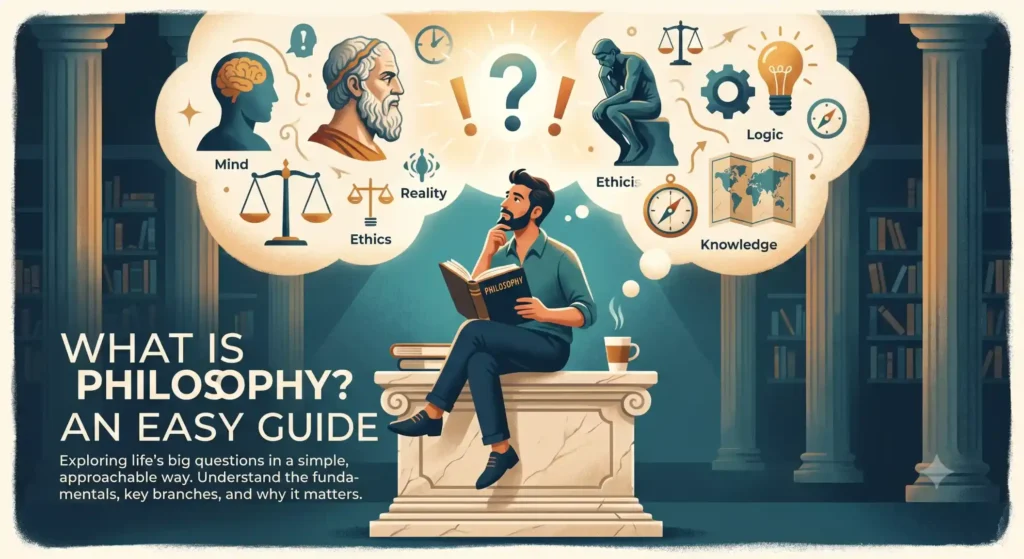
As a teacher, I often discuss philosophy with my students. Questions about life, truth, happiness, right and wrong, and human behaviour naturally come up during our conversations.
Although I am not a teacher of philosophy, I have always been interested in the subject. Whatever I have read, learned and understood, I am trying to explain here in my own simple words. My aim is not to give an academic explanation, but to make philosophy easy for anyone to understand.
So, let us start with a simple question.
What Is Philosophy?
The word philosophy comes from ancient Greek and is commonly understood as “love of wisdom.”
In simple words, philosophy is about asking important questions and trying to understand them through careful and logical thinking.
For example:
- Why are we here?
- What is the meaning of life?
- What is right and wrong?
- How do we know something is true?
- Do we really have free will?
- What makes us happy?
- What is reality?
Philosophy does not always give us one final answer. Instead, it teaches us to think more deeply about the questions.
The Main Branches of Philosophy
1. Metaphysics – What Is Reality?
Metaphysics deals with questions about existence and reality.
For example:
- What really exists?
- Do we have free will?
- What is the nature of reality?
- Is there life after death?
These questions may not have simple answers, but thinking about them helps us examine our understanding of life.
2. Epistemology – How Do We Know?
Epistemology is the study of knowledge.
It asks:
- How do we know something is true?
- Can we trust our senses?
- What is the difference between knowledge and belief?
- How can we decide whether information is reliable?
This is particularly important today because we receive so much information through social media, websites and AI.
Instead of immediately believing something, we can ask:
“How do we know this is true?”
3. Ethics – What Is Right and Wrong?
Ethics deals with morality and human behaviour.
It asks:
- What is right and wrong?
- Is it always right to tell the truth?
- What makes an action good or bad?
- What does it mean to live a good life?
These questions are part of everyday life, even when we don’t call them philosophy.
4. Aesthetics – What Is Beauty?
Aesthetics deals with beauty, art and creativity.
As someone who teaches filmmaking, I find this especially interesting.
Why does one person love a film while another person dislikes it?
What makes a story powerful?
What makes something beautiful?
These are philosophical questions about art and beauty.
The Importance of Logic
Philosophy also teaches us to examine our reasoning.
For example:
- All humans are mortal.
- Socrates is human.
- Therefore, Socrates is mortal.
This is a simple example of logical reasoning.
Logic helps us identify whether an argument actually makes sense. It is useful not only in philosophy but also in our everyday decisions.
Why Do I Discuss Philosophy With My Students?
For me, philosophy and creative work are closely connected.
A filmmaker observes people, society, relationships and human behaviour.
An actor tries to understand a character’s thoughts and motivations.
A writer asks why a character makes a particular choice.
All of these involve questions such as:
Why do people behave the way they do?
What makes someone good or bad?
What does a person really want?
That is where philosophy can become useful for creative people.
Philosophy in Everyday Life
You don’t need to be a philosopher to think philosophically.
When you ask:
“Am I living the life I really want?”
or
“How do I know this information is true?”
or
“Was what I did right or wrong?”
you are already asking philosophical questions.
Philosophy simply encourages us to stop, think and question our assumptions.
My Simple Understanding of Philosophy
From whatever I have read, learned and understood, one thing stands out to me:
We should not be afraid of questions.
A good question can make us think. A different point of view can make us examine our beliefs. And sometimes, understanding a question is more important than finding an immediate answer.
As a teacher, I don’t expect my students to simply agree with me.
I would rather they ask:
“Why?”
and then think for themselves.
Final Thought
Philosophy begins with a question.
It could be a big question like:
“Why are we here?”
Or a simple question like:
“How do I know this is true?”
The purpose is not always to find a quick answer. Sometimes the real value is in learning to ask better questions and think more clearly.
That is why I believe philosophy is not only for scholars.
Philosophy is for anyone who is curious enough to ask “Why?”
References & Further Reading
For the basic concepts discussed in this article, I referred to established philosophy reference sources:
- Stanford Encyclopedia of Philosophy (SEP) – A detailed academic reference for philosophical concepts and branches.
- Encyclopaedia Britannica – Philosophy – A general reference covering philosophy and its major areas.
- Internet Encyclopedia of Philosophy (IEP) – An accessible introduction to philosophers and philosophical ideas.
Note: This article is my own simplified explanation based on what I have read, learned and understood. It is intended as an easy introduction to philosophy, not as an academic or expert study.